Todaya is 8/11
The 230 is GM’s preposterous claim that the Volt electric car will get “up to” 230 miles per “gallon”. If you drop a Volt out of an Air Force cargo plane from 30,000 feet, it will get over 10,000 miles per gallon.
Todaya is 8/11
The 230 is GM’s preposterous claim that the Volt electric car will get “up to” 230 miles per “gallon”. If you drop a Volt out of an Air Force cargo plane from 30,000 feet, it will get over 10,000 miles per gallon.
It’s back. CIT staved off bankrupcty for a few months by entering into a horrible deal with its bondholders. The time’s up.
CIT is down about 20% this morning amid speculation that they will still fall into bankruptcy.
From time to time the subject of “book burning” comes up when some parent objects to the content of a book in a library or a school. Setting aside that there are two types of banning – the librarian who refuses to buy or accept a book, or quietly disposes of a book that they have a personal or political objection to, or liberal patrons who “forget” to return all 37 copies of Rush Limbaugh’s books they borrowed and the library never replaces the book…
Well, that subject is now out in full view. With a paper book in your possession, the words printed on the page stay there as long as you have the book. But what about the new book reader from Amazon called Kindle that lets you download and read books electronically?
The “stuff” is hitting the fan. According to the New York Times, Amazon was selling copies of the book “1984” by George Orwell, from a publisher who did not have copyright permission to sell the book. Amazon remotely deleted the copies of the book from People’s Kindle.
Putting aside the irony for the second, this raises the question of just how far Amazon or other publishers might go in the future (or be forced to go by governments) to delete… or even worse…. modify the text… of books for political or other reasons.
What do you think?
Remember Sally Struthers crying for the starving children and begging you to help the Christian Children’s Fund?
Well, a group called Ministry Watch blew the whistle on the organization in 2004, indicating that their research found no connection between the organization and anything “Christian” – other than to entice Christians to give. As a result of that investigation, the organization recently has been renamed to ChildFund International.
MinistryWatch describes ChildFund as more of a Community Development Organization – the organization has no statement of faith, doesn’t require its members to be of any faith, does no religious teaching and does not engage in trying to get people to become Christians. The fund was originally called the China Children’s Fund.
But the important thing is we’re saving the Children, after all.
When San Francisco’s muni system was having its computer troubles, they decided to put a real time display of what the system operator sees on the terminal – onto the internet, so irate passengers could appreciate what was going on. If you’re a streetcar/computer geek like me, this is very interesting to watch for hours on end – if you’re not, you’ll probably find it really boring.
The display is a bit spartan, since the system operator knows what it means. Here is a typical display with a little annotation and explanation:
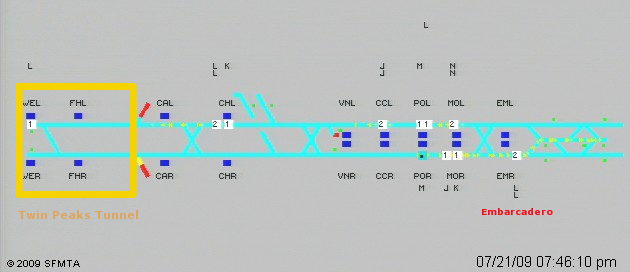
West is to the left, north is to the top, although the tunnel is not actually straight nor perfectly east/west. This is a typical railroad dispatcher control display – it is showing the relative position of important things it is controlling. Actual distances also are compressed and not proportional.
Here is an overall system map to help figure things out:

The Market Stree subway runs from the Embarcadero station to the East Portal of the Twin Peaks Tunnel. Twin Peaks Tunnel was built in 1918 – the subway was started in the 1960s, The two red lines near the CAL/CAR are interconnections with the surface line on Market Street. Prior to the opening of the subway, that is how streetcars temporary got into the Twin Peaks tunnel while the subway was being built. They are now used only in an emergency or infrequent transfers of equipment.
Each train in the subway shows up on the blue lines as a number, which indicates the number of cars in the train. .
Above/below the lines are the station designators, with the L/R at the end indicated Left vs Right. The Blue rectangles are the platforms. The 5 eastern ones are center loading platforms, and the outer 4 have separate platforms on each side of the tracks.
Up above/below the station designators is the route designation of each train… J, K, L, M, N,T. If the letter is in black, the train is operating under computer control. If it turns Yellow or white, the train is on manual operations.
It is normal practice in the subway to join together cars from trains going to different destinations to get more trains through the subway. When the trains reach West Portal, the combined trains are decoupled and go their own ways. If you ride Muni, you want to be sure you get on the correct car 
In this example, there are 2 trains both at platform POL, but they are not coupled. That’s why the L is waaay up high on the display. If they were coupled together, the display would show ML.
The yellow dots indicate the path that the train is going to take.
Now for some other situations:
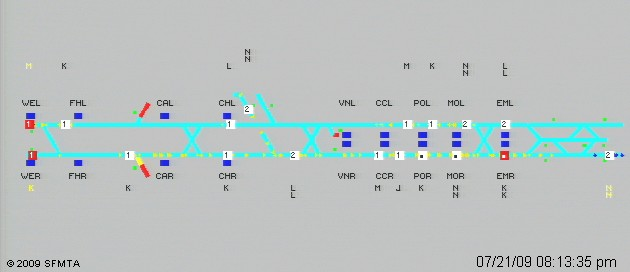
When the train icon turns red, that means the brakes are being applied (WEL/WER). When the number changes to a dot, that means the doors are open in the station (EMR).
The N and J trains don’t go through the Twin Peaks Tunnel. The 2 car N train just east of CHL is coming in off the street, and about to join the mainline. The N train East of the Embarcadero has gone beyond the turnaround tracks and is headed out of the tunnel to begin street running. The T line also goes beyond the tunnel, runing down the East side of downtown to serve the AT&T Baseball stadium and connect with Caltrans station, which provides commuter rail service to the Southern suburbs, and then continues in the new 3rd Street Cooridor to connect to another CalTrans station that has never been built because Muni and Caltrans don’t talk to each other, and CalTrans wanted money to double track their lines into the station at 4th and King. [Do you really want the government running your health insurance?]
If the Giants are in town, look for a lot of extra N/T(K) trains. “T” trains show up as “K” because the control system software has not been updated yet.
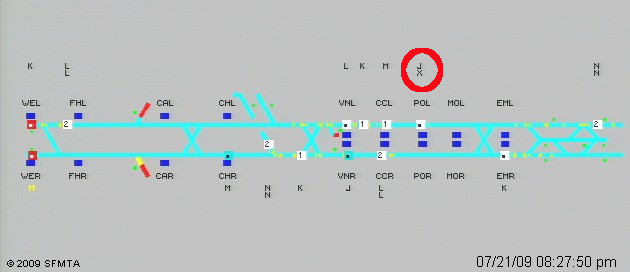
The train circled in red is a 2 car train – JX… The X indicates that the train is going out of service (I think – it’s now 8:30 PM and rush hour is long ago over)
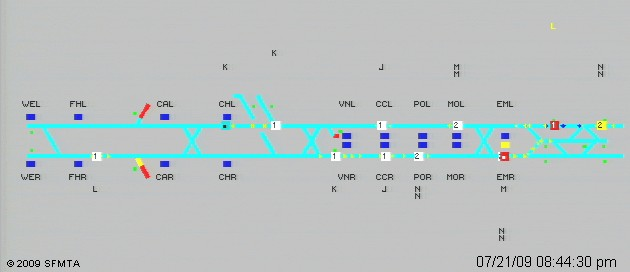
This image captures a few more interesting things:
The station platform at EMR has turned yellow. There are two trains at the station – a 1 car M train going into the Y to switch directions, and a 2 car NN train that is going straight and about to leave the tunnel heading east (then south). The Yellow indicates that the Dispatcher is holding the train at the station even though the train could proceed.
A common problem in all transit is “bunching”. If a train (or bus) gets too close to the one in front of it, fewer passengers will have shown up at the stops. If the train/bus picks up nobody it spends less time stopped, and will get even closer to the one in front of it, and you can wind up with one train/bus filled to capacity followed by 3 completely empty trains/bus.
An experienced driver knows his/her job is to stay on schedule, not to “go as fast as I can”, even if the passengers yell at you to go faster. Knowing that issue, you can often save yourself a lot of grief during rush hour, by letting the first train/bus go by if it is completely packed. More than likely, another one that is almost completely empty is right behind it with lots of empty seats. It pays to know human nature
Over of the right side, a 2 car NN train has just entered the system. It’s train indicator is yellow indicating that the train is also being “held”. There is a 1 car “L” train in front if it on “Manual”.
A more detailed description can be found here.
During the depression, a company was started in Winston-Salem, North Carolina (center of the Tobacco Universe) called Krispy Kreme. They made donuts that are pretty much devoid of any nutritional value other than lots of sugar and fat – but CHEAP. The company was very popular and quickly grew.
The basic business model as they grew was – they developed a machine that did almost all of the work of making the donuts, and the machine in operation was an attraction within the store to take the kids to and show the machine making donuts.
Stores had a counter with places to sit and hot coffee. Stores were open 24 hours a day and are a social gathering place for the community, especially at night when nothing else is open in small Southern towns. People would go there and light up a cigarette, buy a few donuts and a cup of coffee and talk to their friends for an hour or two. It was a favorite place for college kids to go when pulling an all nighter studying for a test, with the easy availability of lots of sugar and caffeine. Invariably, the people working behind the counter were Social Security age women with gray hair and hair nets, and being smart wasn’t a job requirement.
The donuts made in the store were also packaged and sold at local grocery stores with trucks delivering them fresh each day. The company also engaged in aggressive fundraising – if your boy scout troop or high school band wanted to make money, Krispy Kreme would send a truck loaded with 1000s of boxes of donuts hundreds of miles away and the kids would spread out ringing doorbells selling donuts for $1 a dozen… (1960s). That’s probably how most people became aware of Krispy Kreme if you didn’t live in the South. Krispy Kreme is as much a fixture of the Southern culture as Hardee’s, Morrison’s Cafeteria and Waffle House.
Enter the Nasdaq bubble of the late 1990s – Krispy Kreme was one of the last companies to “go public” before the Nasdaq Bubble burst. In June 2000, Krispy Kreme was talked into launching an IPO to raise about $60m organized by Germany’s Deutsche Bank, with loan participation from Wachovia and Branch bank – two banks located in North Carolina. The idea was that the infusion of cash would speed up the expansion of the company into new territory. People who had ever lived near a Krispy Kreme store would flock to one and stand in line for hours to get their Krispy Kreme fix. (the company immediately fled to the NYSE)
Now being burdened with a large amount of debt (Yes, I am drawing a parallel to the radio business), the “New” Krispy Kreme became “modern” to increase their free cash flow – modeling themselves after Starbucks. Instead of a counter with crowded seating and strangers talking to each other, you walk though a line in single file and sit at a table so far away from every other table you can totally avoid any human contact. The coffee was replaced by bottled water, mocha, and fresh fruit juices. Little old ladies with hairnets were replaced with young gay men and other appropriately “diverse” people. And No Smoking. [I’m describing the store here in Connecticut that opened around 2003]. Sounds like a European or Californian concept of Krispy Kreme – in fact the company expanded into Europe, and most of the United States.
But most importantly, the donuts were EXPENSIVE. They were the same old cheap ingredients made by the same machines, but were even more expensive than Dunkin Donuts or the donuts already for sale in grocery stores or old fashioned bakeries. It seemed to me they “dialed back” the machine to have it make the smallest possible donut it could make and still be cooked.
The “big excitement” of opening day lasted about a week. Those who knew Krispy Kreme and were counting the days (me!) were stunned how the new management totally missed the point of what they were selling. The “New” Krispy Kreme thought the essense of KK was the red sign in the window that says “Hot Donuts” when the machine is running. Those who had never experienced Krispy Kreme reacted with “I don’t get it – these are total junk and priced higher that what my local bakery charges”. Without a positive impression, local grocery stores were not interested in carrying them. If they tried, they didn’t sell at $6/dozen and would just go stale.
By 2005, the company was in serious financial trouble (surprised?). In 2007, with their bank loans coming due, they decided to come out with the Whole Wheat doughnut, for the health conscious. How clueless can one company be?
Franchises were folding (one of the major franchisees declared bankruptcy in 2006), stores were closed, donut production was moved to fewer stores, and the finished donuts shipped to the stores that didn’t have enough volume to justify running a machine.
For the first time in probably three years, I decided to pay a visit to the local Krispy Kreme to see how things are working out. The store was empty. There was nobody in line at the drivethru. The person on the other end of the drivethru speaker was a timid young women of Asian background who spoke in a whisper. The donuts were okay (now up to $7/dozen). I’ve learned by reading Wikipedia that this store in Milford, CT is the last Krispy Kreme still in operation in New England – all the rest have been shut down.
In 2008, the company reduced the transfat content of its donuts. (did I mention the point of their doughuts is that they are anti-health food?). The company stock peaked near $55 in 2002, and is now down to $2.57. They’ve accumulated losses since going public of about $300 million. They’re making a small profit still, but all of the cash is going to try to pay down their huge debts. They breached their loan agreement in 2007, and were granted a reprieve in 2009 by ponying up $20 million in cash.
Donuts are very cheap to make, especially with an automated machine. The “light bulb” hasn’t gone on yet that if you have no sales volume, employees standing around with nothing to do – but a product with a very high markup, the way out of your problems is to compete on price to get back the efficiencies of scale of running that donut machine 24 hrs a day and rebuilding the brand. And tell the European managers to go back home. I don’t think any of that is going to happen and they will soon be a memory.