For a very long time, Chicago has been a mess for railroad traffic. Too many junctions, too many grade crossings, overcrowded rail yards, too many looters and thugs.
Railroad consolidation and Canadian Pacific buying the Illinois Central and EJ&E and building a bypass around Chicago has helped quite a bit, along with intermodal freight largely ending the purpose of large classification yards.
But the railroads know this is a temporary solution, but longer term a railroad needs to be built way out in the country very far from civilization. It is worth going 100 mikes out of the way to avoid wasting 2 days just to get through Chicago.
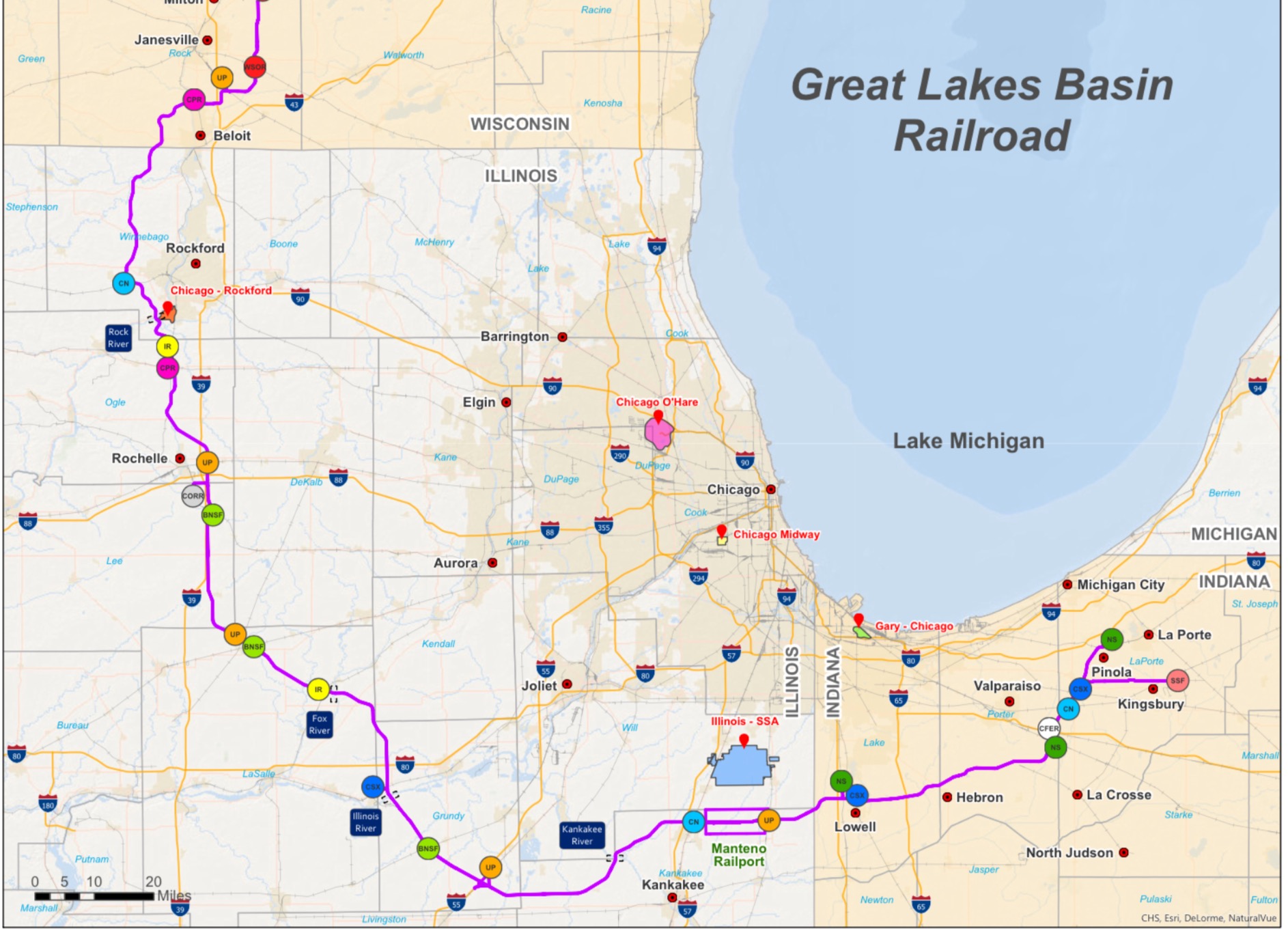
So the Great Lakes Basin railroad is attempting to jump through all the NIMBY, environmental and regulatory groups who refuse to allow the railroad to be built. You literally can’t build a new railroad in the United States.
Mr Trump, please pick up the White Privilege Courtesy Phone™ to receive an important message.
I guess the CREATE program (public/private) v. private only was not enough.
http://www.createprogram.org/linked_files/status_map.pdf
Very interesting. A lot of the issues in Chicago are caused by the Metro commuter rail system having largely taken over freight railroads, leaving overnight as the only time the freight traffic can move freely.
I go back and forth on railroads and capitalism. Construction of long distance railroads took off after the civil war. Everyone got in the railroad business. Chicago is pretty much where everyone agreed to meet. Saint Louis was offered to be the center of the universe – keep in mind this was 50 years before automobiles.
Competition is good – to a point, but it left us with a country where there is no uniform system for the meaning of signals, redundant parallel lines, different operating rules… there are some standards just because railroads needed to interchange cars with each other, like standard couplers and strength requirements.
Other than a few sections owned by Amtrak and the oddball military railroad, the railroads are privately owned, just as the “electric grid” is. Barack Obama makes it clear on a regular basis he thinks these things are government property. I think Trump may have the same view.
To put the size of the problem in perspective, 500 freight trains a day travel through Chicago. This Great Lakes Basin RR is very selective in the types of trains that will use it, and they figure it could handle 100 trains a day. Most of it is double tracked, so that works out to 4 trains an hour at crossings all day long…
There is a similar truck-only toll road being built through the same area of Indiana to divert through trucks out of the congested NW Indiana and Chicago freeways. It face similar opposition – I haven’t followed it close enough to know the current status.
I’m going to get in trouble for saying this, but President Obama’s “You didn’t build this” speech was mostly right, and where I struggle with my Libertarian emotions – his remark was directed exactly at people like me. Unfortunately he made it confrontational and adversarial, but that’s just the way he is.
A modern society requires cooperation and a role by government. When you flush your toilet, you don’t want to think about what people did 100 years ago building sewers. When you turn on water in the sink, water just comes out. When you throw out garbage, it has to go somewhere. When you drive in your car someone built the streets, put up stop lights, planned for future capacity, clears the snow and repairs the potholes.
Libertarians like to view civilization as a freebie – we shouldn’t have rules, everything should be free, just sit around all day smoking pot and do whatever you want when you want. Waste your 12 years of free public education. The things you depend on were built by prior generations and are not free. If everyone was libertarian and we just end government, civilization falls apart. I don’t want to live in a survival of the fittest world like Libya.
On the other hand, governments will increase their power and regulation until the entire society screeches to a halt, waiting for soviet style central planning to approve every minor project, believing that government planners are more intelligent than market forces. No private entity would ever spend $1.4 billion to build an LRV system to connect the university to downtown Charlotte.
Finding the balance is the hard part – everyone thinks they should make the decisions
At the core of the problem is a very fundamental legal principal in transportation – I call it the “who was here first” rule. It applies to roads and railroads, and between railroads, and ships on waterways
Since most railroads are 150 years old, generally the railroad was there first. So if a city is unhappy with a grade crossing on a busy street – well, the railroad was there first. Eliminating the grade crossing is not the responsibility of the railroad, especially the funding part. So there are three main options – build a road bridge over the tracks (the least disruptive), bury the road under the railroad – underpasses are chronic drainage problems and construction requires disrupting rail traffic, or raising the railroad tracks. That is the most expensive option since trains can’t go up and down steep grades like cars and trucks can. Closing redundant crossings is another option.
So CREATE was initiated by Mayor Daley in 2003 because railroads are choking the city. Most of the funded projects involve Amtrak or the Metro commuter rail.
Where two competing railroads have to cross each other, The Who was here first? Rule was very important. People would leverage the rule to disadvantage competitors. If there was an existing rail line, the worst possible option is a junction – an at grade diamond where the tracks cross each other. The first railroad operates the control tower, signals and switches and train schedules, and the newcomer pays all of the costs. In the event of congestion, the first railroad controls “who goes next” and whose train sits still for four hours. It was not uncommon for cities or states to block one railroad.
The preferred method is the new railroad build a “flyover” bridge to go over the first railroad – during construction there may be some interference with operations on the first. If there are economic reasons, the two railroads might cooperate and interconnect, but it isn’t a requirement.
In Chicago, the Chesapeake and Ohio built tracks in SouthEast Chicago to get their passenger trains to the loop, but the government blocked building a flyover across the Illinois Central mainline. As a result, they had to incorporate a legally separate connecting railroad that acquired tracks and built a route far to the west of downtown and then head back east to reach their passenger train station. I believe at one time there were seven different passenger stations inside “the loop”. Going anywhere to anywhere by train meant changing between stations carrying around your luggage
Boy how I enjoyed trains when I was a kid. Yes – they still went “choo-choo” in those days 🙂 I know we will never again have a vast, modern rail system, but I can dream can’t I?
Briand, you would be amazed of the technology currently used . Todays fuel efficiency locomotives get a lot of horsepower out of a gallon of diesel fuel. Obo has used the EPA to hammer them with tier 4 emission standards. They have made locomotives very costly. I bet Norfolk Southern would like to have back that Wabash line across northern Indiana to Chicago. It went to Gary and Westville IN and east to Toledo. It was just south of Porter IN.
I bet CSX would like to have their Car ferries across Lake Michigan now. That was their bypass back in the day. They would need a bigger boat now as cars are 260,000 lbs now.
pretty wild
parrott
Similar thing is going on with diesel trucks and pollution. If you listen to the Midnight Trucking Redeye guys, they talk about the new fluid they have to buy that is used to clean up the pollution. Indiana Jack on the YouTube video is constantly annoyed by the “regeneration” process. It is a bit like self cleaning ovens – the soot is gathered inside the system and when it is necessary, captured soot is heated up to 1000 degrees, where the carbon is made into carbon dioxide – still a “pollutant” but at least not particulates in the air.
I’m not sure I’m on board with disbanding the EPA, but I would support a freeze on any more stringent goals and maybe roll back the current rules by 10% – since we created all this elaborate technology, etc… that breathing room would allow a sudden freedom to rethink things. Just the other day, I was thinking “the kidz” have no idea that it used to be difficult to start your car – that turning the ignition key didn’t work 100% of the time. For you old timers, don’t press the gas pedal to the floor on a cold morning. Your car doesn’t have a choke or a carburetor any more 😉
The regen process is key to a new class action suit against Cummins/Dodge for the Ram Trucks. People ignored the need to regen, and destroyed the system. Then Dodge would often deny the warranty claim. The Owners manual said that at least once a week you needed a long freeway type journey, and if you didn´t do so it would crash. If I hadn´t seen Indiana Jack thanks to you, I wouldn´t have understood what was going on, as the lawyers didn´t do a good job explaining it.
Indiana Jack’s Volvo/Cummins is old enough he doesn’t have to deal with DEF
http://www.discoverdef.com/def-overview/faq/
There has been a lot of consolidation in the truck stop business. The big guys have DEF at their pumps, so you just pump it in an add it to your tab
Other big changes are trucks having APUs to generate power overnight instead of idling (and wearing out) the engines. Idling burns about a gallon an hour. As an alternative there is a service where a hose is connected to your cab window and keeps the cab warm/cold and has high speed Internet access.
The blue states and cities have pretty much adopted no-idling rules with big fines to go along with their front license plates.
Also, I guess the Cummins/Dodge trucks that had the problem had a non-DEF system like the VWs that has a catalyst that wears out if not treated properly.
“,,,old timers, don’t press the gas pedal to the floor on a cold morning. Your car doesn’t have a choke or a carburetor any more “<
yeah, 1985 Mustang LX 302 V8. We had that car when we got married in 89. I would warm it up in the morning for her to go to work. If you could catch it on the start, two pumps of the accelerator, it would hit and start almost immediately , miss it and it was a long crank, with multiple pumps, (if weak battery), go back in house.
You can tell a carburetor car today when following. You smell the fuel.
Parrott
And the smoker
>”I’m not sure I’m on board with disbanding the EPA, but I would support a freeze on any more stringent goals and maybe roll back the current rules by 10% “<
I agree with that. That low hanging fruit part of diesel emissions, say 80%, is easy to remove and not very costly.
That last 20% of the diesel emissions the marginal cost is not work the marginal gain. Let technology catch up. Reliability really took a dive in from about 2008 until lately. Ford had bad issues, They ditched Navistar and designed their own diesel engine 'scorpion' .
GM is using Isuzu based diesels 'duramax', they got that over heating thing worked out I think.
I have a 2005 Dodge with the Cummins, it and the last year 06 of the 5.9 engine, and it wrote the book on reliability on the engine. They can have it when they pry my cold dead fingers off my truck !
It is such a good truck. Pulls the Airstream with ease.
It has a catalytic converter, and that's it. No fluid required from the 'constellation uryon' : )
I didn't know about the Class action suit against Cummins & FCA. That's killer.
Jeep and Ram are all that is making money for FCA.
parrott
Hey Parrot, couldn’t help but comment… even a week late (been offline while migrating from MI to AZ this past week, pulling an Aistream).
Diesel emissions vs MPG has reached the point of diminishing returns with EPA. VW was doing consumers a favor by tuning for fuel economy.
We had a 2001 Dodge 5.9 Cummins. Sold it and got a 2000 7.3 Powerstroke. The Cummins was solid, but just too loud in cabin and poorly implemented (VP44 pump + 47RE trans). The 7.3 is quieter, but has a more complex injection system… however, no catalyst, no EGR, and no DEF. They can pry mine when they pry yours.
I was astounded when Fiat bought Chrysler… the Damlier merger ruined Mercedes quality from 1999- 2008. Looks like they tossed a hot potato over to Fiat, as it’s been one recall after another for FCA, mostly on the Chrysler side.
Hey Chairman , awesome, you migrating down for the winter ? I just saw your post, Airstreams pull so well don’t they!
yeah don’t let no one talk you out of that 7.3 !
Yeah that ’47re’ was good for a gas engine,
but not a diesel. I have the 48RE, where the 8 is for 800 ft pounds, so its good. Just have to keep that fluid clean.
Hope you had a good trip,
yeah FCA is bonkers,
have a good one
Parrott
I should throw in the obligatory point that in 2003, there was no expanded Panama Canal to siphon off container traffic and the fracking boom and murder of the coal industry have drastically changed what moves on the railroads. If the keystone XL pipeline was built and we repealed the ethanol mandate, rail traffic would fall.
I studied Transportation and Public Utilities in a Big 10 Business School, right before they eliminated the major in the late 80´s. The thing they have in common is that they tend towards monopolistic behavior because they have high fixed costs and low variable costs. Its usually very cheap to add another car to the train. When the system reaches capacity, like in Chicago, it causes additional difficulties. When transportation was regulated, there were distance rate sheets per ton and each type of good was given a rating. Coal might be .8 and Cigarettes 3.3. It would cost say $100 for a base journey between two cities, but the Coal would be adjusted to cost $80 and the cigarettes would cost $330. Railroads lost the higher rated freight first. That upset the system and the regulated profits.
Ah, the good old days of the ICC and rules like no backhaul loads unless you owned the truck and the goods. I worked briefly for a company in Troy just after deregulation that was trying to build a system for load matching. It was ahead of its time and they had the wrong technology – they had gone bankrupt trying to chase the Advance Shipment Notifucation business for the auto companies (1986ish).
Indiana Jack should show up here sometime,
Parrott
One of his videos shows him driving through Charlotte a few days after the “riots”. He was hoping he didn’t get pulled over by a mob and assaulted.
There was one video of him in New Jersey where he swore off on every taking a load to the Northeast again, no matter how attractive the rate
I had a dream last night I was ‘yardmaster’ for NS at a local yard.
I had to get a boxcar of flour and a reefer full of meat, fueled up and ready for pickup on a train that goes from Harrisburg PA to Memphis TN and connect with UP.
That I remembered my dream was different.
Train 201
Don’t know what triggered that
parrott
That’s a pretty specific dream.
I had a dream I was on the roof of a building and the building collapsed under me, only to realize there was never a building there in the first place.
Yeah it was. I use to Play Railroad Tycoon ( Platinum) about ten years ago pretty regularly. It was good . They don’t make it anymore.
worked on the truck today, busted my knuckles pretty bad. I guess I’m not twenty four anymore,
Parrott
I figured maybe Elvis had ordered some tacos. Was that Memphis or Nashville? I get those two confused. Which one is the hell hole?
Maybe with Fidel dead, we can resume rail service to Havana. I remember Charles Kuralt doing a series of programs about US 1 and ending at the dock at Key West where the ferry used to go to Cuba.
https://www.floridamemory.com/items/show/24501
https://www.amazon.com/dp/B005DVIOOK?psc=1&smid=A2RQ38FFUL7LO9
In depth coverage of this proposed new railroad
http://northernpublicradio.org/topic/glbr-down-line