Google is the most likely candidate. Apple is an alternative.
I draw your attention to the following picture (geek warning)
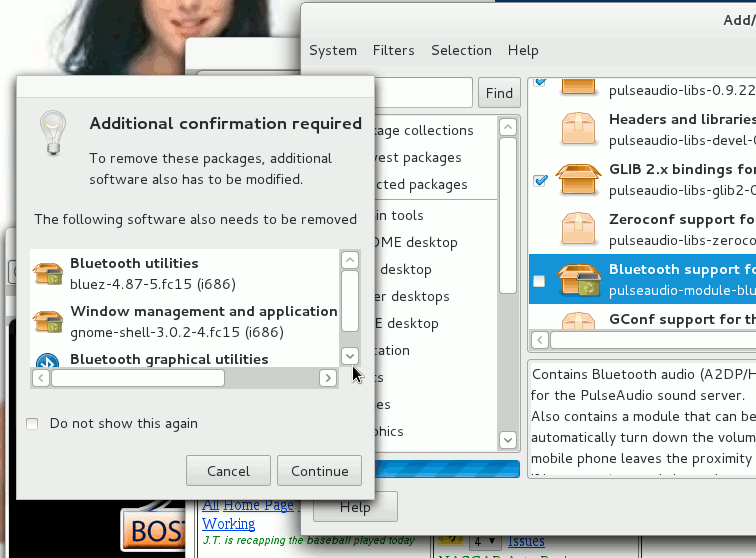
Complex software has dependencies, and poorly designed (or unsupervised) software will have bizarre dependencies. PulseAudio is a piece of software (this is Fedora 15 that came out in May).
My logs are filling up with errors from PulseAudio, so I figure I’ll remove things that don’t have a purpose and see if that’s why it is complaining. I spot “Bluetooth Support for PulseAudio”, which allows bluetooth devices to access a music library. My desktop doesn’t have bluetooth, so that’s pretty logical. So I tell Fedora I don’t need Bluetooth support for my music library I don’t have.
So it looks around and concludes that in order to not have bluetooth music support, it must completely remove Bluetooth support (not a big deal, but not logical), but it also must remove “Gnome-Shell”, which is a key part of the Graphic Environment. This is roughly like going to your car dealer and asking how to remove the cigarette lighter and being told the only way to do that is to remove the engine!
Being the kind of person I am, I said “Go ahead” to see if it would really do something that stupid.
It was. Upon rebooting, the system would not start The Gnome Windows-like interface started, but would not login because there was no gnome-shell to do the login.
Ultimately, I had to search using my iPhone to find out how to escape from an unstartable gnome desktop (Ctrl + Alt + F2), get a command shell and reinstall gnome-shell manually.
Every piece of software activated on a “standard” distribution (“distro”) is a potential security risk. I want nothing running on the system that isn’t necessary and it’s there for a reason. Activating everything by default reduces confusion for getting the system working, but leaves a lot of dangerous junk sitting around.
>”I want nothing running on the system that isn’t necessary and it’s there for a reason. “<
Exactly, Amen Brother. Happy Independence day Art !
Not to mention “lean mean Linux” (Fedora version) won’t boot on PC with less than 1GB of RAM – no problem with a new PC, but onenuche Linux used to fill was it could run on old computers that were below current minimum requirements for Windoze.
Must concur with DevilsAdvocate, although I would tend to suggest a PC Linux OS (PCLOS) variant at PCLinuxOS.com
NOTE: I just checked the PCLOS site and was disappointed to see they have separated it into a standalone site/distro link, it’s on the right column of the home page, under: “PCLinuxOS Gnome Website”. This is a very recent change (all 7 distros were available on the site) and typifies the ongoing organizational chaos that plagues many Linux distros.
PCLOS has (had) several ‘Live’ CD versions which you can test-drive without installing. Gnome, KDE, LXDE, and others are available and some will ‘liveboot’ with 256 or 512 of RAM.
If you want a minimal installation using Gnome, then I would suggest the ZenMini version, which leaves out a lot of the fluff of the full Gnome installation. ZenMini is what I use for LAMP.
Once you get the system configured the way you want it, you can remaster a custom LiveCD installation iso disc image.
One caveat with PCLOS, the setup will default to using the BFS kernel, which doesn’t play well with Synergy and a few other utilities, so you need to manually select the standard kernel… as I recall, you can select it during initial setup. Otherwise, you can change it (via Synaptic) once the installation has completed.
CentOS is another option, or FreeBSD/NetBSD for purists.
Okay, I need to back-up… PCLOS has really botched their website and distro links these past few months.
Fortunately, somebody in Japan (!) archived almost every PCLOS LiveCD .iso image since 2007… I’ll be grabbing a few of these while they’re available. 🙂
http://ftp.riken.go.jp/Linux/pclinuxos/live-cd/english/preview/
The ZenMini (Gnome) version is the 20th link from the top and link title is: “pclinuxos-ZEN-mini-2010.1.iso” and has an MD5 file to check the iso file integrity.
FWIW:
“Minime” (minimal install of KDE)
“ZenMini” (minimal install of Gnome)
Damn… SCRATCH the above link, and go up one level to the stable distros, ZenMini is first link:
http://ftp.riken.go.jp/Linux/pclinuxos/live-cd/
I’m trying to decide what my risk tolerance is for doing risky stuff 🙂 I have Fedora 15 running on my PC well enough for it to be the real server, at least temporarily.
The “real” server is totally hosed. I was in a hurry when I ordered it, and frankly don’t even remember the details – the price of getting older. I had been running on a small aging server up until the 2008 election, and ordered a replacement – dual processor dual core system with 4 GB of ram, and a hardware RAID array.
The installed Fedora 6, which was already unsupported, and partitioned the RAID array as one big partition, with /boot, /, and /home all sharing the same filesystem.
Upgrading from Fedora 6 to Fedora 7 remotely wasn’t an option, and I had a stable system…. so no reason really to upgrade. I’m on mySQL 5.0 and php 2.1 – my memory was I did that upgrade myself, but I’m thinking I may have been remembering the old server.
What I realized recently is I don’t even have a compiler on this system – the yum archives are long ago gone. The system is in Chicago, so I can’t just walk over to it. They want $160/hr to do work on the system.
Last night, I got rid of the swap partition – it was in its own partition with 4 GB of space – which I reformatted to a Linux ext3 filesystem. Somewhere, I do have a thing that supposedly will do a power reboot over the internet – I vaguely remember trying it once and it didn’t work.
So I was reading how to upgrade Fedora remotely, and I’m trying to decide if I’m willing to crash and burn. Plan B is to just buy a cheap PC at walmart and hang it off uVerse, or maybe get a new server at a lower cost with automated provisioning that won’t charge me $200 for a setup fee.
With a free partition, the approach seems to be to create a new /boot – with the ISO and the necessary tools, and edit the grub bootloader files to tell it to boot from the new /boot. I’m not averse to using the 4 GB for the OS (/boot, /bin, /sbin, etc… and taking /dev/sda1 and turning it into /home…. and booting from /dev/sda2
Somehow, I think there will be a gotcha there doing something not so logical.
Okay, I thought the machine in question was sitting next to you, or in another room.
Tried Fedora once late in 2010… it failed to recognize a lot of my hardware, whereas PCLOS installed on all four of my machines: an old PII and 3 Dell Precisions (M70 laptop and two dual-Xeon desktops circa 2005).
PCLinuxOS was forked from Mandrake/Mandriva.
For remote server admin, CentOS or a flavor of (Free)BSD Unix seems to be a preferred setup.
Regarding Linux app packages: yes, the setup and dependencies are insane, but just try telling a Linux zealot how to improve & market it… 😉
Your mention of the *BSD systems made me think of OpenBSD, too. It takes a bit of time to configure an OpenBSD system, but from everything I know, they’re stable and pretty secure. Not only that, but they’re somewhat slow to adopt new packages. That’s not always a great thing for someone looking to use the latest and greatest, but for someone who wants to avoid a rapidly changing system and is looking for stability and a set of packages that won’t be snatched out from under them at some point, it seems ideal.
If you’re looking for a fairly minimalist system with low system requirements (the FAQ said 64M of RAM is the minimum to boot) and don’t mind a bit of experimentation, Art, that might be the way to go. The biggest caveat that I can think of that might really trouble you will be hardware support. Newer hardware just isn’t supported the way it is on Linux.
Indeed, the *BSD flavors are rock solid web servers… especially if you don’t require a GUI or monitor for the box (i.e. a headless server).
When I needed to use FreeBSD and didn’t want to bother with X-windows (9 years ago), what I would do is edit the BSD/Apache config files on Windows with NotePad, and then FTP the files back over to the FreeBSD machine. No ‘vi’ or CLI unless absolutely necessary for reboot, etc.
I notice the Fedora website indicates it requires 768+ MB for GUI… sounds like the resource hog might be the new Gnome 3 interface.
I know that this sort of suggestion is the root of many a geek holy war, but have you considered using a different distribution? I’ve used Ubuntu server edition on a few machines before, and I think it starts off as a fairly minimum installation. If you still need Gnome and such, you can install a minimal version.
So are you thinking I might be trolling for geeks? 😉
The only real reason I am using Fedora is it was on my first server (well, Redhat) back around 2000. I’ve never had a GUI up until now – for the first few years, I was on dialup. I use pico^h^h^h^hnano to edit, but the PHP I edit and test using apache/PHP/MySQL under winXP then scp the updates to the server. The only problem that creates is the religious divide over cAsE sEnsItIvItY in file names and identifiers. I like to use MixedCaseMode and prefer it not be case sensitive, but I’m a product of neither the Remond *lpszBulgarianReverseNotation convention or the C obfuscation coding standard.
I initially installed Fedora 14 and then upgraded it to 15 just for practice. F15 really sucks. One of the new rules is that your desktop can’t have a desktop. They’re so stuck in the notion “this is not Windows” they went out of their way to make it different.
Fedora’s charter is constant change – end of life is one year from release. That’s just insane with in OS built on a 35 year old software base. I don’t need a GUI. To the extent I do, webmin works great.
Way back in my young days, all I needed to know about X was that the books just describing it took up an entire bookshelf. That’s when I decided I would not be doing that for a living – nor would I be writing C windows programs. Most of what I wanted to do worked just fine in visual basic, without having to go to microsoft school for 6 months.
So CentOS is probably good enough for me. I clobbered F15 by accident and reinstalled F14 from the liveCD USB stick I created a month ago, and I’m much happier. Most of the streaming stuff is working well (which of course needs the GUI).
The one thing I’ve learned for sure is I’m a WinXP Spades addict. It’s what forces me to boot back in Windoze every few hours.
“…I’m a product of neither the Remond *lpszBulgarianReverseNotation convention or the C obfuscation coding standard.”
LOL Amen to that!