Now admittedly, McClatchy has their own agenda, but…
“About one-third can name the three branches of government. Fewer than one-fifth of high school seniors can explain how citizen participation benefits democracy.”
Any comments or observations?
(The quote is from the newspaper, it isn’t a quote directly from O’Connor)
After following a few bread crumbs, the source of her statistics is here:
http://nces.ed.gov/nationsreportcard/civics/
Here is what passes for an acceptable answer from a 4th grader:
Q: Your class at school has a new student from a country that has laws that are very different from those in the United States. Your teacher has asked you to help your new classmate learn about important rights that belong to citizens of the United States. [my emphasis]
Write down TWO important rights that people have in the United States that you think your new classmate should know about. Then tell why it is important to have each of these rights.
A: Laws
Why? If there were no laws, everything would be messed up.
Eighth grade sample question about the balance of powers:
“The chart below shows how each of the three separate branches of the federal government can limit the powers of the other two. Complete the chart by filling in each of the empty boxes. The completed chart should have one power for each branch of government and one way in which that branch’s power is checked by another branch.”
The question spots that Legislatures make laws and they can impeach judges
(Silly me, I thought controlling spending was a legislative power to limit the power of the executive branch)
The example considered “acceptable” filled in:
The legislature can be controlled by the other branches by vetoing their laws
The Executive Branch gets its power by approving laws and can be controlled by taking them out of office.
The Judiciary Branch gets their power because they think of laws.
12th grade – how well is the indoctrination going?
“Refer to the passage below.
America is . . . the great Melting Pot! Here you stand, good folk, think I, when I see them at Ellis Island, here you stand in your fifty groups, with your fifty languages and histories, and your fifty blood hatreds and rivalries. But you won’t be long like that, brothers . . . Into the Crucible with you all! God is making the American.
— Israel Zangwill, The Melting Pot, 1908
Define what is meant by the term “melting pot” as it is used in the Zangwill quotation.
Good Answer:
“America was often referred to as the Melting Pot. The meaning is that many different cultures live here and will meld together in harmony”.
Do you think that the term “melting pot” is appropriate to describe the United States? Give one reason to support your answer.
“I do not believe Melting Pot is an appropriate term. Though there are many cultures and beliefs here now, we have not all blended together and become one. We are still diverse and different”.
Ding! Ding! Ding! We must not let the Fort Hood Massacre get in the way of our diversity! Go to the head of the class – you pass!
and God has nothing to do with America in 2013!
If you don’t know the background of Israel Zangwill (I didn’t)
http://en.wikipedia.org/wiki/Israel_Zangwill
He was a Russian immigrant of Jewish background. The point of his play (and his philosophy) was that now he is an American, and no longer a Jew. Progressive Republican president Theodore Roosevelt leaned over at the theater and gave him a high five.
There was no example of the answers that were considered only acceptable or worse.
For those of you have to view everything from the perspective of race (aka the Education Department), here is the results broken out
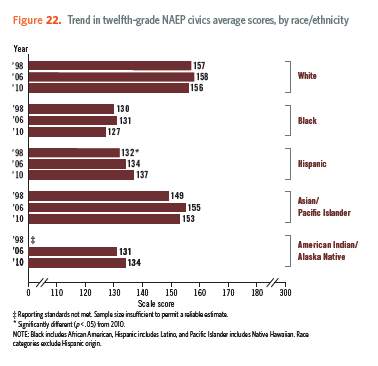
The second group of the lines is the group that voted 95% for president because they believe him to be of their tribe.
Now that IS messed up.
I struggled a lot in school. The “complete” answer to the question to name two rights that Citizens have answered “Freedom of Association”. I would have graded that answer is wrong. The reason is the Bill of Rights applies to everyone in the jurisdiction of the United States. There are relatively few rights that are specific to being a citizen. You have the right to vote. You have the right to run for public office (unless you supported the Confederacy). You have the right to be issued a US Passport.
Legal resident non-citizens have the right to assemble, freedom of religion, right to a trial by jury if accused of a crime, the right to be secure from unreasonable searches. Not widely known is if you are a legal resident with a fixed address (like a college student in Boston) the 2nd amendment applies to you, too. As long as you are of age and not disqualified for some other reason, you have a right to own a gun to the same extent as a citizen. A court challenge in Cambridge Mass found that exact situation to apply.
The “melting pot” answer was good but imagine if you lived in the Middle East where it seems everything is viewed from the perspective of religion.
http://www.washingtonpost.com/blogs/worldviews/wp/2013/08/27/the-one-map-that-shows-why-syria-is-so-complicated/?tid=pm_world_pop
So once we start killing people to stop the killing, how do we know which people are “the enemy”?
You would think John Kerry (who served in Vietnam) would be especially sensitive to this problem. Hey soldier, $5 long time.
When I was living in Chicago before (1988-1991), one of the things that saddened me was a “public service” program, probably on Public TV.
The premise of the show was promoting some organization for peace or social justice or the likes. The “exhibits” were children from Yugoslavia with their parents proudly exclaiming “I am a Serb!” and “I am a Croate!”
These were children born in the United States. Chicago metro area is filled with ghettos of immigrants who resist assimilation even after multiple generations. The US is about baseball, hot dogs, apple pie and Chevtolet, not soccer, tofu, bagettes and Yugos.
The best way to learn something is to do some research (Wikipedia maybe) using several references, then compile the data and write a 1-2 page essay. Grade the papers on grammar, spelling, syntax, spelling…..
Rush is pushing a new book for children 9-13 years old to teach American history, but something tells me the book would still be ‘advanced’ reading for a lot of kids that age, unless they are home schooled. Anyway all that aside, the BlameStream Media types have already panned the book claiming it will be politically biased. Of course the book has not been published and no one besides the publisher has read it yet.
Ooops!!! this was supposed to be a Reply to the post below at 6:23 pm. I failed the test!
If I was answering the Melting Pot question but the opposite answer, I would have to answer something like – 1908 was the early days of the Progressive movement, in which the belief emerged that for social justice to prevail, people needed to understand that becoming part of a single collective consciousness and surrendering individual artifacts like religion and cultures is necessary to advance civilization. The last sentence is asserting that the new progressive social movement was redefining God as the glorious movement to global equality and the end to corporate greed and exploitation of the workers.
W00t – home run!
Do you want hot sauce for your burrito?
Just one more note – a one sentence answer to an open ended essay question is a “complete” answer? Some of the questions for 12th graders were multiple choice questions, giving even less insight.
If they just let the students use Wikipedia, imagine how smart they’ll be!
Here is a poll for you, I got 1 wrong, see how you can do – it is fun
http://www.pewresearch.org/quiz/the-news-iq-quiz/
13 out of 13 – I’m a top 1%er. Please don’t hurt me.
I wasn’t sure about the blond woman, but I think I saw her picture in the news.
Of course now they have tied a couple pieces of data to my cookie